With a lot of joy and gratitude I look back at an amazing time that I’ve spent with my thangka students on the island of Sri Lanka.
This art retreat was fully booked, with students that came flying in from all over the world: The Netherlands, Singapore, United States, Belgium and England. Some of them combined this trip with a vacation in Sri Lanka or elsewhere in Asia.
The retreat was organized together with The Buddhist Library in Singapore. The spiritual director of this Buddhist center is Ven. Banthe Dhammaratana, who you see on this picture standing in between all the thangka students. Ven. Banthe is Sri Lankan and also has a big temple, the Bellanwila temple near the capital Colombo, and the Paramita Buddhist Centre, near Kandy, Sri Lanka. The latter is a retreat center, beautifully situated on a rock in the jungle, where our course was held, with subject ‘Guan Yin, the female Bodhisattva of Great Compassion’.
Sightseeing tour to Anuradhapura, Polonnaruwa & Dambulla
After Buddhism started in India, Sri Lanka was the very first country where Buddhism spread, in the 3rd century BCE, way before Buddhism traveled to the rest of Asia (China, Japan, Korea, Tibet, Birma, Thailand, Mongolia, Bhutan, etc.)
After the drawing and painting week our group, together with Ven. Banthe, traveled to the most famous Buddhist Sites in Sri Lanka, including Dambulla, Anuradhapura, Polonnaruwa. It was a wonderful 4 day vacation all the students, who had become friends in the meantime.
NOTE:
We are aiming to organize this special art retreat every three years.
If you want to stay informed please subscribe to the Newsletter
A short blog this time, as I’m super busy preparing for the Buddhist Art course that I will offer in Sri Lanka from Feb 23 to March 5, which is organized together with The Buddhist Library in Singapore.
The course is fully booked, with students flying in from all over the world: Singapore, The Netherlands, USA, Belgium, Austria and the UK.
Sightseeing tour
Sri Lanka was the first country where Buddhism spread, already in the 3rd century BCE, way before Buddhism came to the rest of Asia (China, Tibet, Japan, Korea, Birma, Thailand, Bhutan, Mongolia etc.)
Very special about this course is that it includes a 4 day sightseeing tour to all the famous Buddhist Sites in Sri Lanka, such as Anuradhapura, Polonnaruwa and Dambulla.
Will this course be held next year?
We don’t know if this course will be organized more often, but if so we will inform you via the Upcoming Buddhist Art Courses page or via the Newsletter.
‘Gravure’ of Green Tara
In February I also made a gravure of Green Tara, after one of my drawings of her.
I engraved her face in a metal plate, which is very hard to do, and made a couple prints by using an etching press:
Creating a large Tibetan Mandala
with Carmen Mensink
[su_photo_panel color=”#970f00″ shadow=”0px 1px 2px #eeeeee” photo=”https://www.tibetan-buddhist-art.com/wp-content/uploads/2018/12/Museumnacht-Nieuwe-Kerk-Tibetaanse-Mandala-Carmen-Mensink-1-1.jpg”]More than 100 Visitors joined in painting this mandala during Museum Night![/su_photo_panel]
Some years ago, Carmen painted the specialMandala of the 5 Elements, a mandala that consists of the elements of Earth – Water – Fire – Air – Space, that you see below.
Tibetan Mandala of the Five Elements, painted by Carmen Mensink
The Nieuwe Kerk (New Church) on Dam Square in Amsterdam (in the heart of the historical city centre) asked Carmen Mensink to create an event for Museum Night, and she thought that it would be great to create a large (2x2m) version of this special mandala, with the visitors that walked in during Museum Night.
After a lot of preparation in the weeks before the event, Carmen and her assistant Roméo set everything up in the choir of the church in the day time.
The mandala was set up in between the two wishing trees by Yoko Ono, where people could write a wish on a small piece of paper and hang it in one of the trees.
When the doors of the New Church opened at 7pm for the start of Museum Night, the first visitors that stood in line were very happy to make a start with the mandala, and started to paint from the center, going outwards.
More and more people joined. Some joined us and painted for 5 minutes, others stayed for hours.
[su_photo_panel color=”#970f00″ shadow=”0px 1px 2px #eeeeee” photo=”https://www.tibetan-buddhist-art.com/wp-content/uploads/2018/12/museumnacht-nieuwe-kerk-tibetaanse-mandala-carmen-mensink-foto-Roel-Determeijer-5.jpg”]Photo by Roel Determeijer[/su_photo_panel]
During the hours of Museum Night, besides guiding the painters, Carmen explained all the backgrounds and meanings of this particular mandala.
The basis of the old Indian Ayurvedic Medicine was formed by these 5 elements of fire, earth, air, water and space. Later on, this system was incorporated in Tibetan Medicine.
These five elements and their energies also live within ourselves.
They are connected to our chakras and also correlated to emotions, body types, illnesses, thinking styles, and character for example.
Furthermore, the colors that are used in this mandala are the colors of the 5 Buddha Families. and each color has deep symbolism.
[su_photo_panel color=”#970f00″ shadow=”0px 1px 2px #eeeeee” photo=”https://www.tibetan-buddhist-art.com/wp-content/uploads/2018/12/museumnacht-nieuwe-kerk-tibetaanse-mandala-carmen-mensink-foto-Roel-Determeijer-7.jpg”]Photo by Roel Determeijer[/su_photo_panel]
And as the evening slowly grew into the night, and more and more visitors put in their joy and effort, the mandala came more and more into existence.
Through Carmen’s information and the lovely vibe, visitors started to have lively conversations together, while working on the mandala.
[su_photo_panel color=”#970f00″ shadow=”0px 1px 2px #eeeeee” photo=”https://www.tibetan-buddhist-art.com/wp-content/uploads/2018/12/museumnacht-nieuwe-kerk-tibetaanse-mandala-carmen-mensink-foto-Roel-Determeijer-4.jpg”]Photo by Roel Determeijer[/su_photo_panel]
She furthermore explained that this particular mandala was used centuries ago by Nepalese and Tibetan doctors (a doctor practicing Tibetan Medicine is called amchi) to explain the relationship between the diseases and their treatments.
This thangka -if you compare it to other Tibetan mandalas- is a very simple one. It’s a copy of Carmen’s teacher Andy Weber’s Five Elements thangka, which is in turn a copy of a Nepalese mandala from the 16th Century.
When it got closer to the end of the evening (2am) the final touches were painted, such as some shading effects (see left and right picture above). The Amsterdam Museum Night 2018 was an incredible night, where people met each other over art, meditation and wonderful conversation.
The Mandala is still on view!
This large Mandala of the 5 Elements, that carries the joyful energies of over 100 people, is still on view at the exhibition ‘The Life of Buddha, Path to the Present’, in De Nieuwe Kerk on Dam Square (right in in Amsterdam’s city centre), until Feb 3, 2019.
In this exhibition, more than sixty works of art, both old and new, have come together spectacularly in De Nieuwe Kerk. You can admire a wealth of millennia-old objects and modern artworks by, among others, Ai Weiwei and Yoko Ono. The oldest object dates from the third century, the youngest from 2018; and a few works of art have been made especially for this exhibition.
When you visit the exhibition, Carmen Mensink’s Tibetan Mandala artwork can be found in the choir of the church, in between the wishing trees of Yoko Ono.
The Exhibition was opened by the Dalai Lama
On Saturday September 15, 2018, His Holiness the Dalai Lama opened the exhibition ‘The Life of Buddha, Path to the Present’ in De Nieuwe Kerk (the New Church on Dam Square in Amsterdam).
The exhibition tells the life story of the Buddha. Born in the fifth century BC. as a wealthy prince named Siddharta, he opted radically for another life at the age of 29. His life phases symbolize Buddhism and form the story of the exhibition: birth, transition, enlightenment, first teachings and death. Read more about the exhibition The Life of Buddha – Path to Present
The Dalai Lama looking at his personal thangka of Buddha Shakyamuni surrounded by scenes of his life, that he loaned to this exhibition. Photo: Jeppe Schilder
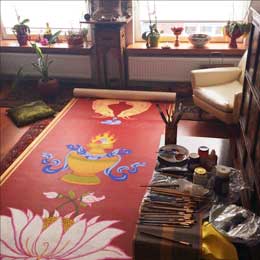
The red carpet painting with Eight Auspicious Symbols welcomed the Dalai Lama, created by Carmen For the previous visits of His Holiness the Dalai Lama to The Netherlands in 2009 and 2014, according to the Tibetan Buddhist tradition, thangka painter Carmen Mensink was asked to create large paintings of the 8 Auspicious Symbols to welcome this special master in her country. For his visit to Amsterdam and Rotterdam in 2018 she was asked for this again -a very big honour.
HH the Dalai Lama walks over the 8 Auspicious Symbols while greeting different visitors, who are waiting with a white kata (blessing scarf) in their hands to pay their respect to him.
Big Card, size: 6×8″ (15x21cm) Price: €4 per piece / 5 pieces: €15 / 10 pieces: €25 (Excl. shipping costs)
Larger discounts are possible when ordering larger amounts. Special prices for resellers.
Symposium ‘Compassion & Technology‘
Seated under contemporary artist Ai Weiwei’s artwork ‘Tree’ (2010), HH. the Dalai Lama participated in a dialogue on Compassion and Technology.
He spoke with young people, technological innovators and scientists, including Faculty Members of content partner SingularityU The Netherlands, and with robot AV1.
The dialogue, organized by De Nieuwe Kerk and SingularityU, formed the ceremonial opening of the exhibition ‘Buddha’s Life – Path to the Present’.
The tree of Ai Weiwei is made from old trees in China, a country that is currently undergoing huge urban transformation. In this way he tries to preserve history. In the exhibition it refers to the tree in Bodh Gaya under which Siddhārtha Gautama, the Buddha, found enlightenment, the highest state of consciousness.
After this excited morning at the Nieuwe Kerk in Amsterdam, Carmen and Romeo had to immediately pack up the artworks and travel to Rotterdam, to install the red carpet artwork in the private quarters of His Holiness the Dalai Lama at the Ahoy Convention Center, where he would be welcomed by and walk over the Eight Auspicious Symbols for the next two mornings as well.
HH the Dalai Lama offered several talks and teachings on Sept 16 and 17, 2018. On Sunday he offered a public talk on ‘Why compassion is essential in our troubled world’, followed by A teaching given by GesheThupten Jinpa, who is HH the Dalai Lama’s main translator and is also known for his book ‘A fearless heart: how the courage to be compassionate can transform our lives.’
The day ended with a film screening of ‘The Last Dalai Lama’, directed by Mickey Lemle, about His Holiness’ interest in research into methods through which we can learn to understand our emotions. 12.000 people attended the teachings in Rotterdam. (Photos by Olivier Adam and Jurjen Donkers)
On Monday morning, September 17, HH the Dalai Lama offered a Buddhist teaching on Langri Thangpa’s text ‘Eight Verses for Training the Mind in Compassion.’ This text gives a clear explanation of how to develop and practice compassion.
Carmen’s 8 Auspicious Symbols are featured on stage and on screen. She designed a banner of the symbols for the stage, as the original red carpet painting was installed backstage, at His Holiness’s private quarters at the event hall.
Carmen creating the red carpet with Eight Auspicious Symbols
For the previous visits of His Holiness the Dalai Lama to The Netherlands in 2009 and 2014, thangka painter Carmen Mensink was asked to create large paintings of the 8 Auspicious Symbols to welcome this special master in her country -according to the Tibetan Buddhist tradition.
For his recent visit to Amsterdam and Rotterdam in 2018 she was asked for this again – a huge honour.
Here you can read all about the making of this artwork, the events with the Dalai Lama where this was used, the exhibition of Buddha’s Life that the Dalai Lama opened, and future events coming up (that you can participate in as well!).
The making of:
Carmen started this large project in 2014 when she was asked for this by the organization of the Dalai Lama’s visit in The Netherlands that year.
A very big honour that she happily took on!
It took weeks of preparation, searching for the right kind of canvas, the right paints that would endure rains and storms, the right colors and all the other materials. After this, Carmen and her assistant Roméo drew all the symbols and texts on this 9 meter (30 ft) large painting.
The day before HH the Dalai Lama’s visit in 2014, ten of Carmen’s thangka art students helped her to paint this large red carpet.
Though it was a very long day -we worked almost non-stop from 10am to 9pm- it was a very joyful day!
During the night the paints had time to dry, and in the early next morning Carmen and her assistant Roméo placed the large painting right in front of the entrance of Ahoy, Rotterdam, where HH. the Dalai Lama would offer teachings all weekend.
During the following years, 2015-2017, the artwork was featured several times, such as to welcome Lama Zopa Rinpoche to the new Buddhist Retreat Center in Loenen (Veluwe), as well as during exhibitions at the National Museum of Ethnology in Leiden (Museum voor Volkenkunde), and spiritual center De Roos in Amsterdam.
For the Dalai Lama’s subsequent visit to the Netherlands in 2018, the organization asked Carmen to use this painting again for this major event. It took her a full week to restore, repaint and adjust the artwork.
The red carpet painting was first used in De Nieuwe Kerk (The New Church) on the Dam Square in Amsterdam, where HH the Dalai Lama would open a special exhibition on the life of Buddha and attend a symposium, before he would offer teachings in the subsequent days.
Left: Carmen makes the preparations in De Nieuwe Kerk a few days prior to the Dalai Lama’s visit
Right: On the day itself, the hundreds of people in the church that are attending the symposium are waiting in excitement for HH. the Dalai Lama to enter through this door, where he will be greeted in the traditional Tibetan Buddhist way by The 8 Auspicious Symbols. Photos: Romeo Raspan / Carmen Mensink
Left: Carmen hanging the painted welcome text under which HH. the Dalai Lama will be interviewed by the Dutch press and where pictures with officials will be taken
Right: Carmen with her assistent Roméo under the welcome text Photos: Romeo Raspan / Carmen Mensink
HH the Dalai Lama walks over the 8 Auspicious Symbols while greeting different visitors.
We are also waiting with a white kata (blessing scarf) in our hands to pay our respect to him. When he gets to Romeo he offers him a special and personal blessing, really wonderful! Photos: Carmen Mensink
After HH the Dalai Lama’s spectacular entrance, the Symposium on Technology & Compassion started, where he went into dialogue with young people, technological innovators and scientists.
(you can watch this back via the video below)
After that, HH the Dalai Lama opened the new exhibition ‘Buddha’s Life, Path to the Present’ that can be visited till Feb 3, 2019, see below for more info. Photo: Carmen Mensink
Teachings in Rotterdam
After this excited morning at the Nieuwe Kerk in Amsterdam, Carmen and Romeo had to immediately pack up the artworks and travel to Rotterdam, to install the red carpet artwork in the private quarters of His Holiness the Dalai Lama at the Ahoy Convention Center, where he would be welcomed by and walk over the Eight Auspicious Symbols for the next two mornings as well.
HH the Dalai Lama offered several talks and teachings on Sept 16 and 17, 2018.
On Sunday he offered a public talk on ‘Why compassion is essential in our troubled world.’ Photo: Olivier Adam
This was followed by A teaching given by Geshe Thupten Jinpa, who is HH the Dalai Lama’s main translator and is also known for his book ‘A fearless heart: how the courage to be compassionate can transform our lives.’
The day ended with a film screening of ‘The Last Dalai Lama’, directed by Mickey Lemle, about His Holiness’ interest in research into methods through which we can learn to understand our emotions.
12.000 people attended the teachings in Rotterdam. Photo: Jurjen Donkers
On Monday morning, 17 September, HH the Dalai Lama offered a Buddhist teaching on Langri Thangpa’s text ‘Eight Verses for Training the Mind in Compassion.’ This text gives a clear explanation of how to develop and practice compassion.
Carmen’s 8 Auspicious Symbols are featured on stage and on screen. She designed a banner of the symbols for the stage, as the original red carpet painting was installed backstage, at His Holiness’s private quarters. Photo: Carmen Mensink
Carmen’s behind her booth during this event, where she sold her thangka paintings, thangka cards, bookmarks and stickers, as well as Tibetan and Nepalese jewellery and other precious items. During these two days she raffled 3 thangka workshops to people who signed up to the Tibetan Buddhist Art Newsletter. Photo: Roméo Raspan
Before the Dalai Lama’s public talk on Saturday, Richard Gere, actor and chairman of International Campaign for Tibet (ICT), marked ICT’s 30th jubilee with a discussion about The Dalai Lama’s life inside and outside Tibet. Photo: Olivier Adam
Photo: Jurjen Donkers
Carmen was also introduced to Richard Gere and his wife before that; they had a lovely conversation while waiting together next to the red carpet painting with 8 Auspicious Symbols for the Dalai Lama to arrive.
His Holiness the Dalai Lama and members of the International Campaign for Tibet (ICT) holding a certificate denoting the financial grant ICT will give to the Dalai Lama Institute for Higher Education as a gift of gratitude to His Holiness during their program at the Ahoy convention centre in Rotterdam, Netherlands on September 16, 2018. Carmen’s 8 Auspicious Symbols are featured in the background. Photo: Jurjen Donkers
Big Card, size: 6×8″ (15x21cm) Price: €4 per piece / 5 pieces: €15 / 10 pieces: €25 (Excl. shipping costs)
Larger discounts are possible when ordering larger amounts. Special prices for resellers.
Symposium ‘Compassion & Technology‘
Seated under contemporary artist Ai Weiwei’s artwork Tree (2010), HH. the Dalai Lama participated in a dialogue on Compassion and Technology. He spoke with young people, technological innovators and scientists, including Faculty Members of content partner SingularityU The Netherlands. And with robot AV1. The dialogue, organized by De Nieuwe Kerk and SingularityU, formed the ceremonial opening of the exhibition ‘Buddha’s Life – Path to the Present’.
Photos: Oliver Adam
The tree of Ai Weiwei is made from old trees in China, a country that is currently undergoing huge urban transformation. In this way he tries to preserve history. In the exhibition it refers to the tree in Bodh Gaya under which Siddhārtha Gautama, the Buddha, found enlightenment, the highest state of consciousness.
You can watch the dialogue on Compassion & Technology with HH. the Dalai Lama here:
Opening of the exhibition ‘Buddha’s Life – Path to the Present’ by HH. the Dalai Lama
On Saturday September 15, 2018, His Holiness the Dalai Lama opened the exhibition ‘The Life of Buddha, Path to the Present’ in De Nieuwe Kerk (the New Church on Dam Square in Amsterdam).
In this exhibition, more than sixty works of art, both old and new, have come together spectacularly in De Nieuwe Kerk. You can admire a wealth of millennia-old objects and modern artworks by, among others, Ai Weiwei and Yoko Ono. The oldest object dates from the third century, the youngest from 2018; and a few works of art have been made especially for this exhibition.
The exhibition tells the life story of the Buddha. Born in the fifth century BC. as a wealthy prince named Siddharta, he opted radically for another life at the age of 29. His life phases symbolize Buddhism and form the story of the exhibition: birth, transition, enlightenment, first teachings and death.
His Holiness the Dalai Lama looking at his personal thangka of Buddha Shakyamuni surrounded by scenes of his life, that was loaned to this exhibition. Photo: Jeppe Schilder
Help paint a Tibetan Mandala during the Museum Night 2018!
Tibetan Mandala of the Five Elements, painted by Carmen Mensink
During the museum night on Saturday 3 November (from 19.00-24.00) Carmen will conduct a large painting project, where all visitors can help paint this beautiful Tibetan Mandala of the 5 Elements during the Buddha Exhibition in De Nieuwe Kerk. This is how it is advertized on their website:
Thangka-workshop with Carmen Mensink Are you completely impressed by the Buddhist art in the exhibition The Life of Buddha, and can you stare for hours at the painting (thangka) depicting the life story of Buddha, on loan by none other than the Dalai Lama? Carmen Mensink specializes in making these Buddhist paintings, and gives workshops worldwide in which she shares her knowledge. During the Museum Night, she leads a painting project wherein every visitor of the Museum Night can participate! All night everyone can work on a huge copy of a sixteenth-century Mandala of the 5 Elements used by Nepalese and Tibetan physicians. She not only helps you with painting, but will also tell you more about the backgrounds, symbolism and meaning of this mandala. Nov. 3, 2018, from 19-24 hrs, you can join at any time this evening, and as long or short as you wish. See you there!
To buy a passe-partout for the Museum Night (€19,95) or more info go to Museumnacht Amsterdam
See you soon!
As HH. the Dalai Lama is 83 years old and having some illnesses, this 2018 visit to The Netherlands may have been the last one. This is also the reason why thousands of Tibetans living in Europe came together for a private audience with their spiritual leader in Rotterdam.
We hope and pray that he may stay with us for many more years to come, and keeps on being such an inspiration to so many beings.
Photo left: Olivier Adam / Photo right: Claudia Lucke
Before I traveled to Japan, there was one thing I really wanted to do: to do a special workshop in Kyoto. As I was searching for an authentic Japanese workshop experience, I stumbled upon the Roketsu studio, an old art studio where long time ago the fabrics for kimonos were printed (see the beautiful old wooden templates on the walls).
The studio is run by a lovely middle-aged man and his old mother. Both do not speak English, but show the process of creating a traditional painting by example.
It’s a Japanese batik style painting created with hot wax. Here I explain you the process of the artwork that took me 5 hours to make on a cold and rainy day:
On a piece of white cotton you draw/paint an image with hot wax. The wax is much more difficult to paint with than a regular paint. The brushes are pretty big and therefore much more difficult to paint fine lines.
Most parts of the painting have to be painted with wax twice, in order to create really white spots.
On the left picture it shows my artwork on the cotton: a geisha with cherry blossoms in the background and below her a pond with lotuses.
Next, the white cotton is dyed with indigo (the traditional pigment coming from the indigofera tinctoria plant) for about 10 minutes while you slowly stir the fabric.
Because of the wax that has penetrated the cotton thoroughly, those parts do not catch any indigo paint.
After the dyeing process, the cotton needs to dry for a while, and as you can see the light yellow wax is still on the cotton.
The next step is to remove the wax by melting it away in a large pan of boiling water, as you can see on the right.
The To-ji Temple was and is the headquarters of Shingon Buddhism
On my travels in Asia I’m always drawn to Buddhist temples and, their practitioners and the rituals.
I find it very interesting to see the many similarities in the different Buddhist traditions and countries as well as the many differences.
So when I made my very first trip to Japan earlier this year my main purpose was to not only visit the Buddhist temples but also stay in them and join the ceremonies.
Mount Koya, or ‘Koya-San’ as the Japanese call it, is the holiest place for Japanese Buddhists.
It’s a small mountain village that houses a university dedicated to Buddhist studies as well as 120 temples, some of which offer lodging to pilgrims.
Kukai and Shingon Buddhism
Kukai (Kobo Daishi) introduced the Vajrayana tradition of Buddhism in Japan, named Shingon. In Koya-san’s small museum you can find some superb examples of ancient art that is made within this esoteric tradition.
Shingon-shūis one of the major schools of Buddhism in Japan and one of the few surviving Vajrayana lineages in East Asia.
Originally these esoteric teachings spread from India to China through monks (such as Amoghavajra and Vajrabodhi) who traveled along the Silk Route.
Later, under the auspices of a Buddhist monk named Kūkai, this esoteric form of Buddhism flourished in Japan.
In 817 the great Buddhist monk Kobo Daishi Kukai selected Mount Koya as the training center for Shingon Buddhism. He set up his headquarters at Koya-san and was soon made abbot of To-ji temple. Kukai spent many years of his life meditating and teaching at Koyasan.
Since then hundreds of works of religious art were collected and preserved at Mount Kôya.
The Japanese Buddhist school of Shingon is something of an anomaly. It is a Mahayana school, but it is also a form of esoteric or tantric Buddhism and the only living Vajrayana school outside of Tibetan Buddhism.
The word Shingon comes from the Chinese word Zhēnyán, meaning ‘True Words’, which in turn is the Chinese translation of the Sanskrit word ‘mantra‘.
Staying in a Japanese Temple
The entrance of the Jimyo-in Temple, my room and the view from my room over the temple gardens with the main pagoda where the Buddhist meditations and ceremonies are held
On Mount Koya I stayed in 2 different temples, the first days in the Jimyo-in Temple, a small temple complex with a handful of monks and one assistant. None of them spoke English, so it was a very authentic temple experience, and at the same time that was a pity as I had so many questions that I wanted to ask.
I was given a beautiful authentic Japanese style room with hot tea waiting for me (which was great as the room was cold, as it was still winter time in Feb), and amazing food that was served (see below) and in the early mornings I joined the Buddhist meditations and rituals with the monks.
The second temple that I stayed in was the Kumagaiji Temple, a larger temple complex, and more familiar with hosting foreign pilgrims.
The assistants spoke very well English so I got to ask all the many questions that I had. Both temples were an amazing experience to stay in.
My room at Kumagaiji, the second Buddhist temple that I stayed in
Fire Puja
The Kumagaiji Temple is known for their fire ceremonies, and I was so fortunate to experience this in the early morning, with the main lama of the temple.
It’s a ritual for purification, and that’s why he asked me think of something that I would want to leave behind and write this on a wooden stick and throw it in the fire, while another monk was pounding a very large drum. See the video here:
Through the centuries many of the Buddhist temples in Koyasan -that are traditionally made from wood and paper- were completely burned to the ground, and now I can totally understand why.
Special Temple Food
My very first experience with buddhist temple food during dinner time, and on the right picture I’m still a bit sleepy when having my breakfast in the early morning after the fire ceremony that I attended
Shingon Buddhism is very well known for the special temple food that they offer, which is all super delicious and completely vegetarian (even vegan), so no animals had to suffer for it whatsoever!
The temple food is brought into your room in the evening and in the early morning, and is placed on beautiful small tables from red laquer. The table that is placed further away from where you sit represents an offering for the (your) ancestors, that you think of when you eat the food on it.
Each meal consists of at least 10 different dishes placed in beautiful small porcelain bowls, each dish is a piece of art in itself. Such joy – not only for the mouth but also for the eye! A pot of healthy green tea is sitting next to it and you can order a small bottle of warm or cold sake (rice wine) to drink with your food.
Some of the dishes that are served are: sesame tofu, sauteed mushrooms and spinach, a mix of fried vegetables, soup, pickeled vegetables, and a bowl of rice as well as soy sauce to eat it all with. As dessert there’s some beautifully sliced fruits.
As you really take the time for a meal that is prepared with such care and time, and as you eat in silence and with chopsticks you become very conscious of each bite that you take. The whole experience is like a very special ritual, that makes you very grateful.
During my Buddhist pilgrimage in Japan I had to collect my first goshuin!
Goshuin are the sacred stamps and calligraphy from each temple, that are collected in a special booklet, the goshuincho. Each one is a piece of art in itself. Below some pictures of the very first calligraphy that I collected in it, made by the monk in the video, in the holiest Buddhist temple, the main temple in the pilgrim village of Koyasan, on top of a mountain.
Here you see the monk writing the sacred calligraphy of his temple (that you see above) in my goshuin book:
The goshuincho is a ‘harmonica’ booklet. You can’t use just any booklet, it has to be one that is especially for this purpose.
You can buy them in pilgrim shops, and also in Buddhist temples (that’s where I bought mine, in the very same temple as where the monk made the calligraphy)
In this trip to Japan I collected about 15 calligraphies, and I will absolutely bring my stamp book on my next trip to Japan to collect further!
Earlier this year I went on my very first trip to Japan, a very interesting country that I have been wanting to explore for a long time.
Kyoto was the capital of Japan for much of the country’s history (794 to 1868).
The photos below give a good impression of my experiences in Kyoto -a much larger city than I expected, and also less nice than I expected- and what it looks like today.
For more images on my travels in Asia visit my Facebook page
Even though I stayed in Gion, the geisha district of Kyoto, real geishas can hardly be found anymore in Kyoto.
Due to the enormous growth of tourism in Japan in the past 5 years, real Geishas and Maikos (geisha in training) and can hardly walk the streets anymore, as they are immediately attacked by the cameras and tourists that are following them around.
The picture above of a Maiko was taken at a museum for Japanese culture where she offers a performance in dance, music and tea ceremony every now and then.
The pictures of the ninja and the lantern were taken in the food district in the heart of Kyoto.
My expectations of Kyoto were quite high, I had always imagined a beautiful small city with lots of authentic streets, temples and buildings and full of blossoming gardens and parks. But I must say that I was quite disappointed when I finally spend some days in Kyoto, and that my expectations were waaaaaay too high….. The city is super large and very modern, even ugly looking, with hardly any trees or parks.
The temples that Kyoto is so famous for can be found on the outskirts of the city, but take a lot of time to travel to. The weather didn’t help either, as when I was there most of the days were rainy and very cold cold. I think if the weather is nice it might be good to rent a bicycle to see some of the temples.
So I was very pleased to accidentally stumble upon this beautiful little temple in between the ugly concrete buildings somewhere in the center of Kyoto – and as the rain had just stopped for a few minutes I think it made a great picture!
The ‘geishas’ that you do see wandering on the streets and at Kyoto’s temples are tourist -mostly Chinese girls- as there are lots of shops where you can rent a kimono and matching accessories for a ‘one day geisha’ experience. It does make some great pictures!
Kyoto is absolutely packed with large groups of Chinese people, that do not always act very respectfully towards the Japanese and their culture. This is currently a difficult and serious issue for the Japanese people that are known for their hospitality and respect towards others.
After my classes in the beginning of January I was first time invited to teach a thangka course on Bintan.
Bintan Island is a small Island in front of the coast of Singapore, that belongs to Indonesia.
The Asian Spiritual Classics (ASC), asked me to offer a thangka course on Buddha Shakyamuni (for beginner thangka students) and White Tara (for more advanced students). I met the students at the boat that was taking us to the island – everyone was so excited to go!
Here’s a photo impression of the thangka course on the Indonesian island. If you like what you see join us next time!
Bintan island has parts with a beautiful coast line, but as it was quite rainy in the long weekend that we spend on the island we didn’t swim this time but made some nice walks. We stayed in a wonderful resort with comfortable rooms, a rooftop pool and amazing food – which was all included in the price.
More pictures can be found on the Thangka Painting Facebook Page, when you click on the image below it will take you to its photo album:
Amsterdam in the snow This picture is taken on the yearly skate lane that is built in front of the Rijksmuseum.
Young Dutch Children learn to ice skate by using a chair, so they don’t fall.
After the skating hot chocolate, cookies, and green pea soup will be ready to warm up.
Singapore and Bintan Island thangka courses
Offering Goddess of Music (playing the lute) by Carmen Mensink, showing the painting process in steps
While it was snowing in Holland in the past month, I have been preparing the thangka courses that I will offer in Singapore and Bintan Island, early January.
Bintan Island is a small Island in front of the coast of Singapore, that belongs to Indonesia. I’m invited by the ASC, the Asian Spiritual Classics, to offer a thangka course on Buddha Shakyamuni and White Tara.
If possible schedule wise, I combine my thangka classes in Asia with a vacation.
This year I will be traveling to Japan after the classes in Singapore. I’ve been wanting to visit Japan and its culture, art and temples for a long time and this will be my very first visit, so exciting!
From Japan, I will board on a ship that will visit more places and islands in Japan, as well Taiwan after that. It will eventually embark in Hong Kong, where I will stay for another week. It must be a very interesting city and I’m looking forward to exploring it.
One of the courses that I offered in december had one of my favorite subjects: the 8 Auspicious Tibetan Symbols.
These famous symbols are painted in front of a Tibetan monastery when a high lama comes to visit (see the picture below of the artwork I created for the Dalai Lama) but they are also drawn with colored powder (or wheat flour) or painted on the floors and houses to welcome the New Year.
2016 was a very dark year in very many ways, but I wish that all the symbols that were created in 2016 -such as the wonderful ones of my students as you can see in the pictures below!- may leave a positive imprint onto anyone that sees them and may they create Peace & Harmony for 2017.
A photo posted by Carmen Mensink (@carmenmensink) on
January in The Netherlands started out with snow.
The picture above was taken in the place where I was born, Zwolle.
From this year on I’ll be offering thangka classes in this city, and the first weekend course started in the first weekend of the new year.
The subject was: Buddha Shakyamuni with and without theTorana of the 6 Perfections, which is an elaborate aura around the Buddha, filled with gods and (hybrid) animals that stand for the six qualities that you need to perfect in order to make steps on the spiritual path.
Six days of private thangka teachings in Amsterdam
I regularly get contacted by people who prefer to come for private thangka teachings instead of joining group classes. This month I had several people coming to my art studio in Amsterdam.
Angelika flew in from Munich to work with me for a week. She had already come 2 years before to my extended weekend course in Venice, Italy (a place where I teach every October or November), where she already learned to draw an amazing Manjushri. Now she wanted to take a next step by learning how to paint a thangka out of her drawing.
Manjushri is the Buddha of Wisdom holding a flaming sword in his right hand, that he wields above his hands. This special sword cuts through our ignorance. In his left hand Manjushri holds the stem of a lotus flower that carries the Wisdom Sutra.
I prepared a specific 6 day program for Angelika to reach her goal, that is to learn all the basics of thangka painting to be able to continue at home.
The program included Manjushri meditations in the morning, slide presentations, preparing a thangka canvas and frame, transferring the drawing onto the thangka, the different thangka painting techniques, shading, outlining and gold preparation. We had a wonderful week together.
The last days her husband came over to Amsterdam as well and they enjoyed their time in this beautiful city and visiting the famous museums (Rijksmuseum, Van Gogh Museum). In the pictures you can see the complete day-to-day process of making a thangka.
Individual Buddhist art workshop in Amsterdam
Laurence and Bart are a couple from Belgium who planned to spend a romantic weekend in the beautiful city I live in.
They arrived on Thursday evening in one of the hotels close to the thangka art studio, so they could start their weekend with a day workshop on how to draw the face of the Buddha. Bart was a bit hesitant at first as he had no drawing experience whatsoever, but Laurence insisted it was good to do this workshop as a couple as to connect on a different level together.
After welcoming the couple on Friday morning with coffee, tea and Dutch apple cake I started the workshop with a short guided meditation, after which I explained through a slide presentation and talk the meanings and background of Tibetan Buddhist thangkas, before they learned how to draw the Buddha. In between the drawing sessions we had a wonderful lunch break and at the end of the day the couple had created amazing Buddhas, as you can see from the pictures. Especially Bart was surprised!
Such a lovely thing to come to a thangka class as a couple!
Teaching kids to draw a Buddha & guide them through ‘The Buddha’ exhibition
How I love teaching art classes to teens!
I’m regularly asked by the Tropen Museum in Amsterdam to offer tibetan workshops and guided tours, both to adults and teenagers.
This month I worked a morning with a wonderful school group from Holland with 11 and 12 year olds. Wonderful young beings that were eager to learn and had a lot of questions to ask.
Each and every kid made a great Buddha drawing, after which I took them into the galleries to have a look at other Buddhas from different traditions and to tell them about the life of buddha during the guided tour.
The Tropenmuseum in Amsterdam has also asked me to offer workshops and guided tours to school groups that are visiting the museum during the exhibit. The classes are big, 30 to 35 teens per class, and the teens are aged 13 to 17. The schools come from different cities in Holland.
Guided tours
After each workshop, where the teenagers learn to draw a Buddha in the Tibetan tradition and after the workshop I bring them into the galleries and offer a guided tour through the current exhibition ‘The Buddha.’
Offering teachings to classes from my own high school! It was such an amazing coincidence that in one of the schools that attended my workshop & guided tour was the secondary school that I attended myself, the Carolus Clusius College in Zwolle (Netherlands), of course long before these 15 and 16 year old teens were born.
The exhibition ‘De Boeddha’ runs through Jan, 2017.
The Buddhism Festival Weekend in Tropenmuseum Amsterdam!
In the weekend of Oct 15 & 16, the Tropenmuseum held their wonderful Buddhism Weekend, with lots of different events that were all related to Buddhism and the different schools in Buddhism.
I was asked to offer lectures on Buddhist Art as well as Thangka workshops and leading guided tours through the exhibition The Buddha (in Dutch: De Boeddha as you can on the picture at the bottom of this page) at the Tropenmuseum in Amsterdam, The Netherlands.
Guided tours through the Buddha exhibition
This exhibition about Buddha Shakyamuni, the historical Buddha of our time, and by visiting it you will make a journey through the life of the Buddha, learn about his philosophy and how it spreaded out to other Asian countries.
On the left I point out some elements on an old Japanese scroll. The exhibit is divided in parts that show the different Buddhist countries and their artwork.
The right picture shows a Tibetan thangka depicting the Buddha’s birth, with his mother Maya who holds on tight to a tree when giving birth. Before the Buddha became an enlightened being he was a human just as you and I, he was born as a prince called Siddharta Gautama. And this young boy was a special one, as after birth he immediately started walking and everywhere he put down his feet, lotus blossoms appeared.
The name ‘Buddha’ means ‘Awakened One’ and people started calling Siddharta this after he reached the highest state of consciousness.
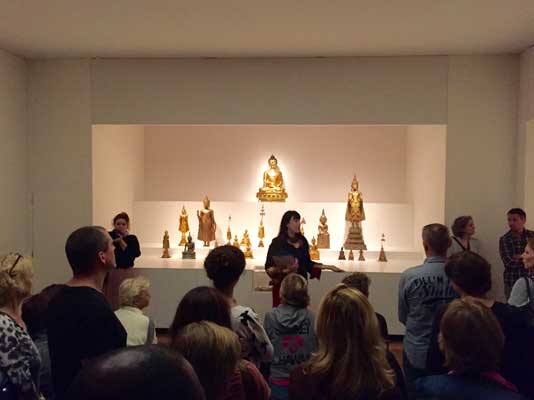
In the Buddha hall at the end of the exhibit, Buddha statues from all the different buddhist countries are brought together. Here I explain about the differences in iconography and style and how you can recognize Buddha statues from certain countries.
Lectures on Tibetan Buddhist Art
During the weekend I also offered several lectures on buddhist art, such as the 8 Lucky Symbols in Tibet.
The set of eight symbols consist of the: Parasol, the Pair of Fishes, the Vase, Lotus Flower, the Conch Shell, the Eternal Knot, the Victory Banner and the Dharma Wheel.
Workshops drawing the 8 Auspicious Symbols
During the weekend I also offered a workshop on the 8 Auspicious Symbols to a group of 30 visitors of the museum.
The wonderful exhibition ‘The Buddha’ can still be visited till Jan 29, 2017!
Opening of the exhibition ‘The Buddha’ in Amsterdam
On Sept 23 I attended the opening of the new exhibition at the Tropenmuseum in Amsterdam called The Buddha.
It’s a wonderful exhibition about Buddha Shakyamuni, the historical Buddha of our time, and by visiting it you will make a journey through the life of the Buddha, learn about his philosophy and how it spreaded out to other Asian countries.
The Buddha exhibition will run through Jan 29, 2017.
Here’s a picture of the big light hall of the Tropenmuseum during the opening of the exhibition The Buddha:
Thangka students raising money to help animals in Nepal
Animal Nepal is an innovative NGO based in the Kathmandu Valley and is run by an enthusiastic team of volunteers, who are both local and overseas animal welfare campaigners and educators. Animal Nepal was established in 2004 as a non-profit company and was registered in 2009 as an NGO.
Through practical interventions and awareness-raising, Animal Nepal believes that widespread animal cruelty can be gradually reduced. Hopefully Nepal can become a model country for animal welfare in its region.
For a short time I raised donations for this cause during my thangka classes and my students gathered a total of $112,50. This month I doubled it and transferred $225 to Animal Nepal. It’s a small amount but all bits help! I will continue to raise money for this cause during my classes and will keep on doubling it.
To learn more about Animal Nepal and/or to help this much needed cause, please go toanimalnepal.wordpress.com
Thangka classes in new places
This month thangka classes were organized in new places, such as Utrecht and Den Bosch (in the center and in the south of The Netherlands). Below you’ll find some pictures of it. Joyous days!


 With a lot of joy and gratitude I look back at an amazing time that I’ve spent with my thangka students on the island of Sri Lanka.
 A short blog this time, as I’m super busy preparing for the Buddhist Art course that I will offer in Sri Lanka from Feb 23 to March 5, which is organized together with The Buddhist Library in Singapore.


 During the hours of Museum Night, besides guiding the painters, Carmen explained all the backgrounds and meanings of this particular mandala.

 And as the evening slowly grew into the night, and more and more visitors put in their joy and effort, the mandala came more and more into existence.


 The cards that were made from this artwork can be ordered in the
  Symposium ‘Compassion &
  The tree of Ai Weiwei is made from old trees in China, a country that is currently undergoing huge urban transformation. In this way he tries to preserve history. In the exhibition it refers to the tree in Bodh Gaya under which Siddhārtha Gautama, the Buddha, found enlightenment, the highest state of consciousness.
 Dalai Lama’s teachings in Rotterdam
 On Sunday he offered a public talk on ‘Why compassion is essential in our troubled world’, followed by A teaching given by GesheThupten Jinpa, who is HH the Dalai Lama’s main translator and is also known for his book ‘A fearless heart: how the courage to be compassionate can transform our lives.’
 On Monday morning, September 17, HH the Dalai Lama offered a Buddhist teaching on Langri Thangpa’s text ‘Eight Verses for Training the Mind in Compassion.’ This text gives a clear explanation of how to develop and practice compassion.




 After HH the Dalai Lama’s spectacular entrance, the Symposium on Technology & Compassion started, where he went into dialogue with young people, technological innovators and scientists.


 Before I traveled to Japan, there was one thing I really wanted to do: to do a special workshop in Kyoto.




 The temple food is brought into your room in the evening and in the early morning, and is placed on beautiful small tables from red laquer. The table that is placed further away from where you sit represents an offering for the (your) ancestors, that you think of when you eat the food on it.


 School classes learn how to draw the Buddha!


 I was asked to offer lectures on Buddhist Art as well as Thangka workshops and leading guided tours through the exhibition The Buddha (in Dutch: De Boeddha as you can on the picture at the bottom of this page) at the Tropenmuseum in Amsterdam, The Netherlands.
 Lectures on Tibetan Buddhist Art


 Thangka students raising money to help animals in Nepal
 Through practical interventions and awareness-raising, Animal Nepal believes that widespread animal cruelty can be gradually reduced. Hopefully Nepal can become a model country for animal welfare in its region.