
Painting the Eight Auspicious Symbols to welcome the Dalai Lama in The Netherlands
In Tibet, when a highly respected lama visits another monastery, they are greeted by a painting of the Eight Auspicious Symbols.
 The painting is created by monks in front of the temple. It’s usually drawn on the pavement with colored powder, colored flower, rice, chalk or paints.
The picture on the right was made in 2008 at the Drepung Loseling Monastery in Mundgod (South India) to welcome His Holiness the Dalai Lama on the occasion of the opening of a new temple within the complex.
Dalai Lama in The Netherlands
For the past three visits of the Dalai Lama to The Netherlands (in 2009, 2014 and 2018), Carmen Mensink was asked by the organizers to create such special paintings in order to welcome him to her home country. A very big honour.
She designed and coordinated these big projects and painted them (assisted by some of her thangka students).
Different designs
Carmen created different designs: for the Dalai Lama’s visit to Amsterdam she made a 16.4 ft (5 meter) wide lotus circle and for his subsequent visits in Rotterdam she painted 30 ft (9 meter) long artworks.
See more pictures of the artworks, the making of and read all about the symbolism behind it:
Painting for the Dalai Lama 2009
On occasion of the Dalai Lama’s visit to Amsterdam, The Netherlands, Carmen was asked to paint the Eight Auspicious Symbols, right in front of his teaching hall.

She designed a 5 meter (16.4 ft) wide mandala-like circle and painted it on the pavement with loose pigments and water, so eventually it was going to fade due to… Read More & Making Of
Painting for the Dalai Lama 2014
For the Dalai Lama’s subsequent visit to The Netherlands, Carmen was asked to welcome this great master with a painting of the eight symbols once more.

This time she chose to paint a 9 meter (30 ft) on a background with special paints, something she does not regret as during the event the weather was very rainy and… Read More & Making Of
Painting for the Dalai Lama 2018
For the Dalai Lama’s subsequent visit to the Netherlands in 2018, the organization asked Carmen to use this painting again for this major event.
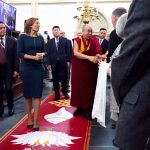
It took her a full week to restore, repaint and adjust the artwork. The red carpet painting was first used in De Nieuwe Kerk (The New Church) on the Dam Square in Amster… Read More & Making Of

Dalai Lama
His Holiness the Dalai Lama (born July 6, 1935) is the spiritual leader of Tibet. His official name is Tenzin Gyatso. He is a lama of the Gelug order (also known as the Yellow Hat school of Tibetan Buddhism) that was founded by Lama TsongKhapa in the 14th Century.
The Dalai Lama is considered to be the successor in a line of tulkus (reincarnated Tibetan Buddhist lamas and masters) who are believed to be incarnations of Avalokitesvara (Tib.: Chenrezig), the Bodhisattva of Great Compassion.
The current Dalai Lama is the 14th in this lineage.
In 1950 China invaded and occupied Tibet brutally, leading the Dalai Lama to fled to India nine years later. Since then, he has been campaigning from exile for Tibet to be given greater autonomy.

Meeting the Dalai Lama
Carmen went to H.H. the Dalai Lama’s teachings often and met him a few times in person, where she offered him some of her artworks.
She recalls her encounters with the Dalai Lama Read More
Related topics

There are different versions of Avalokitesvara (called Chenrezig in Tibetan):
– 4 armed Avalokitesvara
– 8 armed Avalokitesvara
– 1000 armed Avalokitesvara
His mantra is Om Mani Padme Hum, and this mantra is often painted on Mantra Stones